
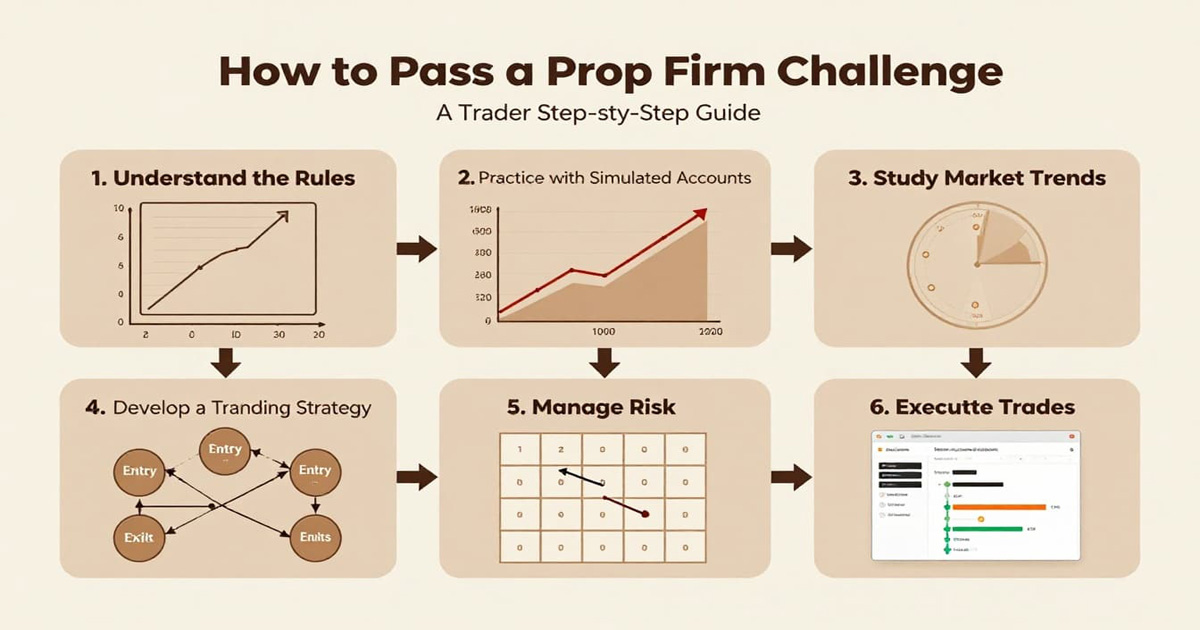

The global prop trading industry has reached a staggering $20 billion valuation, with annual growth projected around 7%. A prop firm challenge serves as your gateway to substantial trading capital without risking your personal money.
Search interest for funded account programs has skyrocketed by more than 500% between 2020 and 2024. The reason becomes clear when you consider the benefits. Prop firm trading lets you access accounts from $10,000 to an impressive $1,000,000 or more. Your profit splits can range from 50% to 90% of your trading gains.
Our comprehensive breakdown will show you how to pass a prop firm challenge successfully. You’ll learn everything from simple requirements to precise execution strategies for prop trading challenges. The opportunity awaits to join 98,000+ traders who have collected more than $9.1 million in rewards. Your account size could grow up to $2 million through scaling plans, and this roadmap will guide you toward that success.
Step 1: Understand What a Prop Firm Challenge Is
The prop trading world has seen amazing growth in the past few years. Skilled traders now have new chances to access big institutional money. You should know exactly what you’re getting into before starting a prop firm challenge.
What is a prop firm?
A proprietary trading firm, or prop firm for short, is a financial company that trades with its own money instead of client funds. These firms don’t just help clients make trades like traditional brokers. They employ traders to generate profits through specific trading strategies in different financial markets.
These firms make money through “proprietary trading” – they use their own funds to trade in markets like stocks, bonds, commodities, currencies, and other instruments. Their goal is to utilize their advantages to get returns that are better than standard investment methods.
Most prop firms use a profit-sharing model. Traders who do well with the firm’s money get a cut of the profits they make. This setup benefits everyone – both the firm and the trader win when trades are successful.
What is a prop firm challenge?
A prop firm challenge (also called an evaluation or assessment) tests if you’re good enough to handle the firm’s money. Think of it as a real-world exam of your trading skills.
You’ll trade on a simulated account that has specific rules and goals. Your job is to show you can make money while following strict risk management rules. A newer study published in by shows that 27% of people fail these challenges because they either break risk management rules or don’t understand the terms properly.
The core of most prop challenges has two steps:
- Initial Challenge Phase: You need to hit specific profit targets (usually around 8%) while following risk limits like maximum daily loss (5%) and overall drawdown (10%).
- Consistency Phase: After you pass the first part, you move to another demo account. The rules are a bit more relaxed, but you still need to show consistent results, usually with half the profit target of the first phase.
Once you pass both phases, the firm gives you real money to trade. You’ll get a share of the profits (usually 80%) from your trading.
This system has made it easier for more people to access big trading accounts. Instead of risking $50,000 of your own money, you might pay $15-$1,000 for a challenge. This gives you access to funded accounts between $5,000 and $200,000, and you keep 70-90% of the profits without risking more of your own money.
How it differs from personal trading
Personal trading and prop firm trading are different in several big ways:
- Capital Source: Personal accounts use your own money – you take all the losses. Prop trading uses the firm’s money, which means less financial risk for you.
- Risk Structure: Prop firms have strict rules about risk management, like limits on losses. Personal trading lets you manage risk however you want.
- Financial Exposure: Personal accounts need a lot of your own money that you could lose. Prop challenges usually just need a one-time fee.
- Trading Freedom: Personal accounts let you trade however you want. Prop accounts often limit your trading style and might not let you hold positions overnight or trade during news.
- Psychological Impact: Trading your own money can mess with your head. Fear of losing can make you hesitate or trade too much.
Prop firm challenges are a great way to get into professional trading, especially if you have good skills but limited money. They let you trade bigger amounts while teaching you proper risk management – this combination can help your trading career take off if you approach it the right way.
Step 2: Know the Rules Before You Start
You need to know the rules that govern prop firm challenge evaluations to succeed. Even if you make money, breaking these critical rules will disqualify you.
Profit targets and drawdown limits
Profit targets are the life-blood of prop trading challenges. Most firms want you to hit 8% to 10% in your original phase and about 5% in later verification phases. To name just one example, a $100,000 account with a 10% profit target means you’ll need to reach $110,000 to pass.
These profit targets mean nothing if you don’t understand drawdown limits – how much you’re allowed to lose. You’ll find two main types:
- Daily drawdown: You can’t lose more than 4-5% of your account balance in a day. This limit starts fresh at market rollover (usually 21:00 UTC). Going past this limit even for a moment will get you kicked out.
- Maximum drawdown: Your total loss limit sits between 5-10% of your starting balance or highest equity peak. Some firms stick to fixed drawdowns (static limits), while others use trailing drawdowns that move up as you make money.
Different firms calculate drawdowns in their own way – some only count closed trades (balance-based), while others include open positions (equity-based). This difference can affect your trading style by a lot, especially if you’re a swing trader who prefers balance-based calculations.
Time limits and minimum trading days
Most prop firms give you deadlines – usually 30 days for the first phase and 30-60 days for the second. Missing your profit targets within these timeframes means you fail, no matter how well you traded.
These deadlines serve both mental and practical purposes. Traders might take too few risks or lose interest without time limits. But super short deadlines can push them into bad habits like overtrading or ignoring risk management.
Many traders now look for firms that offer no time limit challenges. This approach lets them wait for the right setups instead of forcing trades.
Beyond deadlines, firms want you to trade on 4 to 10 different days. This rule stops “one lucky trade” wins and shows you can perform consistently. FTMO, to name just one example, needs at least 4 trading days during evaluation. Some firms get even more specific – they might want 3 profitable days with each day making at least 0.5% profit.
Trading restrictions and lot size rules
Prop firms use various trading restrictions to protect their money and keep evaluations fair. Here are the common ones:
- Position size limits: Your maximum lot sizes depend on account size. Some firms cap a $50,000 account at 20 lots for certain assets.
- Prohibited strategies: You can’t use high-frequency trading, grid trading, martingale strategies, or copy trading.
- News trading restrictions: Trading during major economic releases is off-limits to avoid wild price swings.
- Overnight and weekend positions: Some firms don’t let you hold positions overnight or during weekends to avoid gap risk.
Breaking these rules can get your account closed, profits taken away, or force you to restart the challenge. The consequences change based on how badly you break the rules – you might get warnings for honest mistakes, but serious violations will shut down your account right away.
You must know these rules inside out before starting your challenge. The numbers show this is a big deal as it means that 27% of challenge failures happen because traders break rules, not because they lose money.
Step 3: Choose the Right Prop Firm for Your Style
Picking the right prop firm that matches your trading style is as vital as knowing the challenge rules. Many options exist today, and when you line up your trading approach with the right evaluation structure, your chances of success increase by a lot.
Types of prop firm challenges
The prop trading industry gives traders several distinct evaluation frameworks. Each comes with its own structures and requirements. You should know these simple models:
- One-Phase Challenges: The most direct evaluation structure needs you to hit a single profit target (typically 8-10%) within a 30-day period while staying within strict drawdown limits. These challenges work best for experienced traders with time-tested strategies who generate steady profits in short timeframes.
- Two-Phase Challenges: This model dominates the industry and splits evaluation into two distinct phases. The first phase usually needs 7.5-12% profit with a 5-10% maximum drawdown limit. A verification phase follows with a lower profit target around 5%. This method proves you can stay profitable across different market conditions.
- Three-Step Challenges: A complete evaluation adds one more phase beyond the standard two-step approach. These usually need an 8-10% original target, 5-6% secondary target, and 3-4% final consistency phase. While less common, these programs give the fullest trader evaluation at lower costs.
Instant vs. two-step evaluations
Your biggest choice comes down to instant funding or evaluation-based challenges:
Instant Funding lets you access funded accounts right away without an original challenge phase. You get account access when you pay, with tight drawdown limits (typically 4-8%) instead of proving profitability first. The benefit stands out: immediate capital access without the 1-2 month wait for standard challenges.
Two-Step Evaluations require you to pass two challenges back-to-back before funding. The first step usually has a higher profit target (8-10%), and the second verification phase needs a smaller target (around 5%). Traders who finish both phases get funded accounts with profit-sharing deals, usually 80-90% going to the trader.
These models differ in key ways:
- Fee Structure: Instant funding costs 10x more than evaluation accounts
- Profit Split: Evaluation-based firms pay 80-90% of profits while instant funding pays 50-70%
- Risk Parameters: Instant funding sets stricter rules and lower drawdowns
- Withdrawal Terms: Evaluation-based programs often have better payout schedules
How to match firm rules with your strategy
You need an honest look at your style to find the right firm structure:
- Define your trading style – Are you a day trader, swing trader, or scalper?
- Day traders need firms with low spreads, fast execution, no limits on trade frequency
- Swing traders must have firms that allow overnight positions and weekend holdings
- Scalpers require ultra-tight spreads, low commissions, and zero lag
- Assess your risk approach – Steady traders who take small wins should pick longer timelines and lower daily drawdowns. Aggressive traders who take wider swings need more drawdown room.
- Think over specific strategy needs – How do you handle news events? Some firms ban trading around big news while others welcome it. Do you hold trades overnight or weekends? Many firms limit or penalize holding past Friday close.
- Check platform compatibility – Make sure the firm supports your preferred trading platform (MT4, MT5, cTrader).
- Review payout terms – Look at how often they pay (monthly, biweekly, or daily), profit splits, and scaling plans that let your account grow over time.
Note that finding the right fit for your trading style matters more than finding the “best” firm. The ideal firm has rules that match how you already trade—not the other way around.
Step 4: Prepare Your Strategy and Mindset
Success in any prop firm challenge starts with proper preparation. The difference between passing and failing often comes down to what you do before placing your first trade.
Backtest your trading system
Your strategy needs testing against historical market data without risking real money through backtesting. This critical step reveals whether your approach works in different market conditions. You risk your funding chance without knowing if your strategy works in ground scenarios if you skip this process.
Research shows why this matters: 80% of traders who backtest their strategies see better trading performance. On top of that, it can cut trading risks by up to 50% by spotting potential strategy flaws.
Your backtesting should focus on these key elements:
- Define clear, objective rules for entries, exits, and risk management
- Test in different market conditions (trending, ranging, volatile)
- Track key metrics like win rate, profit factor, expectancy, and maximum drawdown
- Factor in ground trading costs including spreads and commissions
The next step involves forward testing with a demo account to see your strategy’s performance with up-to-the-minute conditions. This connects theory with practice.
Simulate challenge conditions
After confirming your strategy, set up conditions that match your chosen prop firm challenge. Your demo account should have similar parameters – the same starting capital, leverage ratios, drawdown limits, and profit targets.
The key lies in simulating full “challenge cycles” rather than individual trades. This means working with multiple days or weeks of market data while following all rules as if you were in the actual challenge. You should complete at least two full simulations – the first run spots weaknesses, while later runs confirm that you’ve fixed them.
Demo accounts help traders save money before attempting official evaluations. This shows whether you’re ready or need more practice. A detailed trading journal during this process should record your entries, exits and the logic behind each decision.
Build emotional discipline
Poor emotional control and decision-making under pressure affect 80% of traders negatively. Mental discipline matters more than market expertise when passing a challenge.
Revenge trading after losses, overtrading during winning streaks, and chasing volatile markets often destroy prop firm accounts. The “3-Strike Rule” helps counter these issues – stop trading immediately with no exceptions after three consecutive losses in a single day.
These proven methods build psychological resilience:
- Set clear pre-defined rules for entries and exits
- Track your emotional state alongside your trades
- Identify emotional patterns that undermine performance
- Practice mindfulness techniques for 5-10 minutes daily
- Use “reset rituals” like taking a short walk after significant wins or losses
Note that trading follows the “20% strategy and 80% psychology” rule. A strategy with an impressive win rate in demo trading becomes useless if you can’t control the urge to “revenge trade” after two losses.
Testing your strategy and building mental strength before taking a prop firm challenge increases your success chances significantly where most traders fail.
Step 5: Execute the Challenge with Precision
Your prop firm challenge truly begins as theory meets practice. The quality of your execution determines if you’ll join the 20% of day traders who last beyond their first two years of trading.
Stick to your plan
A detailed trading plan guides you throughout the challenge. Start conservatively, especially in your first week when quick results tempt you the most. A $50,000 account should target just $600-$900 profit (20-30% of your goal) in week one.
These risk management rules are crucial:
- The 2% Rule: Never risk more than 2% of your challenge account per trade, though successful challengers usually keep risk at 0.5-1%
- Daily Stop Loss: Your personal daily stop loss should be tighter than the firm’s limit – if they allow $1,000 daily loss, limit yourself to $500
- Consistency Rule Buffer: The firm might limit a single day to 40% of total profit, so keep any day under 30% to maintain a safety buffer
A concrete plan creates a framework that eliminates doubt and keeps you disciplined through market fluctuations.
Avoid overtrading and revenge trades
Overtrading destroys accounts quickly by breaking drawdown rules when traders take too many trades without clear, high-quality setups. You should limit yourself to 3-5 well-researched trades daily to enforce selectivity and patience.
Traders often fall into revenge trading after losses by making impulsive decisions to recover quickly. This emotional response makes them abandon strategy, increase position sizes, and remove stop losses. Bad decisions multiply once this pattern starts.
The “3-Strike Rule” helps – stop trading immediately after three consecutive losses in one day. You should also close your platform after hitting your personal daily loss limit and review trades only once emotions settle.
Track your performance daily
Your trading metrics provide vital feedback for adjustments. Keep a detailed journal that captures:
- Entry and exit points
- Trade justification
- Profit or loss
- Emotional state and market conditions
This record shows patterns in both winning and losing trades, helping you spot emotional triggers before they cause problems.
Weekly analysis of your performance metrics should cover win rates, risk-reward ratios, and risk rule compliance. Traders now use digital tracking tools from basic spreadsheets to specialized journaling software that blends with trading platforms.
Note that successful challenge participants trade less frequently. They focus on clean setups, keep consistent small risk levels, and feel comfortable waiting when market conditions don’t match their strategy.
Step 6: What Happens After You Pass
A successful prop firm challenge opens the door to your funded trading experience. Your proven skills create a new chapter with genuine profit potential.
Getting access to funded accounts
Your account goes through an automatic audit after you reach your profit target. Most audits finish within hours when markets close. Many firms send funded account credentials the same day you pass. Some firms like Phidias let you keep your existing trading credentials, so you can start trading right away.
Prop firms use a tiered approach to funding. You start with a CASH account (simulated funds) to prove your consistency and earn actual payouts. A LIVE account with actual firm capital becomes available after you show reliable performance—usually after three successful payouts.
Profit splits and scaling plans
Traders keep between 70% to 90% of profits in standard profit-sharing arrangements. Several factors shape your split:
- Risk management policies (stricter rules often mean higher splits)
- Market type (forex typically offers 80%, futures can reach 90%)
- Evaluation structure (multi-step challenges generally provide better splits)
Scaling plans help your account grow steadily. To cite an instance, see how some firms offer:
- 25% account increases every two months with steady profits
- 30% growth every four months when you hit 10% profit targets
- Fast-track scaling programs that double your account size after reaching 10% cumulative growth
Staying funded and growing your capital
Your funded status depends on following drawdown limits and trading rules carefully. Successful traders often keep a small buffer in their accounts instead of withdrawing all profits at once.
Balanced performance matters more than one-time wins—that’s why firms use “consistency rules”. Some firms require that your best trading day should not exceed 30-40% of your total profits.
Discipline beats aggressive returns for long-term growth. Traders who deliver steady profits while following risk rules receive progressive capital increases. This approach can grow accounts from $5,000 to $600,000 or more.
Conclusion
Success in a prop firm challenge takes more than just trading skill. Your success depends on strategic preparation, disciplined execution, and a deep understanding of your chosen evaluation’s rules.
The prop trading world gives skilled traders amazing opportunities. You can now access trading funds from $10,000 to over $1,000,000 without putting your own capital at risk. The best part? You get to keep between 50% and 90% of the profits you generate.
Picking the right firm that matches your trading style is crucial. Your success rate goes up when you match your natural approach with the firm’s rules. This applies whether you excel at one-phase challenges, two-phase evaluations, or prefer instant funding.
Preparation is the life-blood of any successful challenge attempt. Most traders fail due to psychological factors rather than strategy flaws. You’ll stand out from the 80% who fail by backtesting your strategy, simulating real challenge conditions, and building emotional resilience.
Discipline becomes your best friend during the challenge. The key is to stick to your plan and avoid overtrading while tracking your results carefully. Note that successful traders focus on quality setups and consistent risk management instead of trading more frequently.
New doors open once you pass and get your funded account. Most profit-sharing deals range from 70-90%, and scaling plans let your account grow over time. Traders who show steady profits can scale their accounts from modest starts to several hundred thousand dollars.
The path to prop firm success demands dedication and discipline. But the rewards make this experience worth it for serious traders ready to prove themselves. After all, you get to trade larger capital without personal risk and keep most of the profits.
Key Takeaways
Prop firm challenges offer traders access to substantial capital ($10K-$1M+) while keeping 50-90% of profits, requiring only evaluation fees instead of personal risk.
• Success depends on matching your trading style with compatible firm rules rather than finding the “best” firm • Thorough preparation through backtesting and simulating challenge conditions prevents 80% of failures caused by poor emotional control • Conservative execution with 0.5-1% risk per trade and daily stop losses below firm limits maximizes passing rates • After passing, consistent performance and strict rule adherence unlock scaling plans that can grow accounts to $600K+ • Focus on quality over quantity – successful traders take fewer, well-researched trades rather than overtrading
The key to prop firm success lies in disciplined preparation and execution rather than aggressive trading. Most failures stem from rule violations and emotional decisions, not unprofitable strategies. By understanding firm requirements, preparing thoroughly, and maintaining strict discipline during execution, traders can access institutional capital and build sustainable trading careers without risking personal funds.
FAQs
Q1. How long does a typical prop firm challenge last? Most prop firm challenges have a duration of 30 to 60 days. However, some firms now offer “no time limit” challenges, allowing traders to focus on consistent performance without the pressure of a deadline.
Q2. What is the 2% rule in prop firm trading? The 2% rule is a risk management guideline that suggests traders should not risk more than 2% of their account balance on a single trade. Many successful prop firm traders actually keep their risk even lower, around 0.5-1% per trade.
Q3. How do prop firms calculate drawdowns? Prop firms typically use two types of drawdown calculations: daily drawdown (usually capped at 4-5% of account balance) and maximum drawdown (ranging from 5-10% of starting balance). Some firms use balance-based methods (only closed trades count), while others use equity-based calculations (including unrealized profits/losses).
Q4. What happens after passing a prop firm challenge? After passing, traders typically receive access to a funded account within 24 hours. Most firms use a tiered approach, starting with a simulated CASH account before progressing to a LIVE account with actual firm capital. Profit-sharing arrangements usually range from 70/30 to 90/10 in favor of the trader.
Q5. How can I improve my chances of passing a prop firm challenge? To increase your chances of success, thoroughly backtest your strategy, simulate challenge conditions in a demo account, and focus on emotional discipline. During the challenge, stick to your trading plan, avoid overtrading, and maintain strict risk management. Remember, successful challenge participants often trade less, not more, focusing on quality setups and consistent performance.