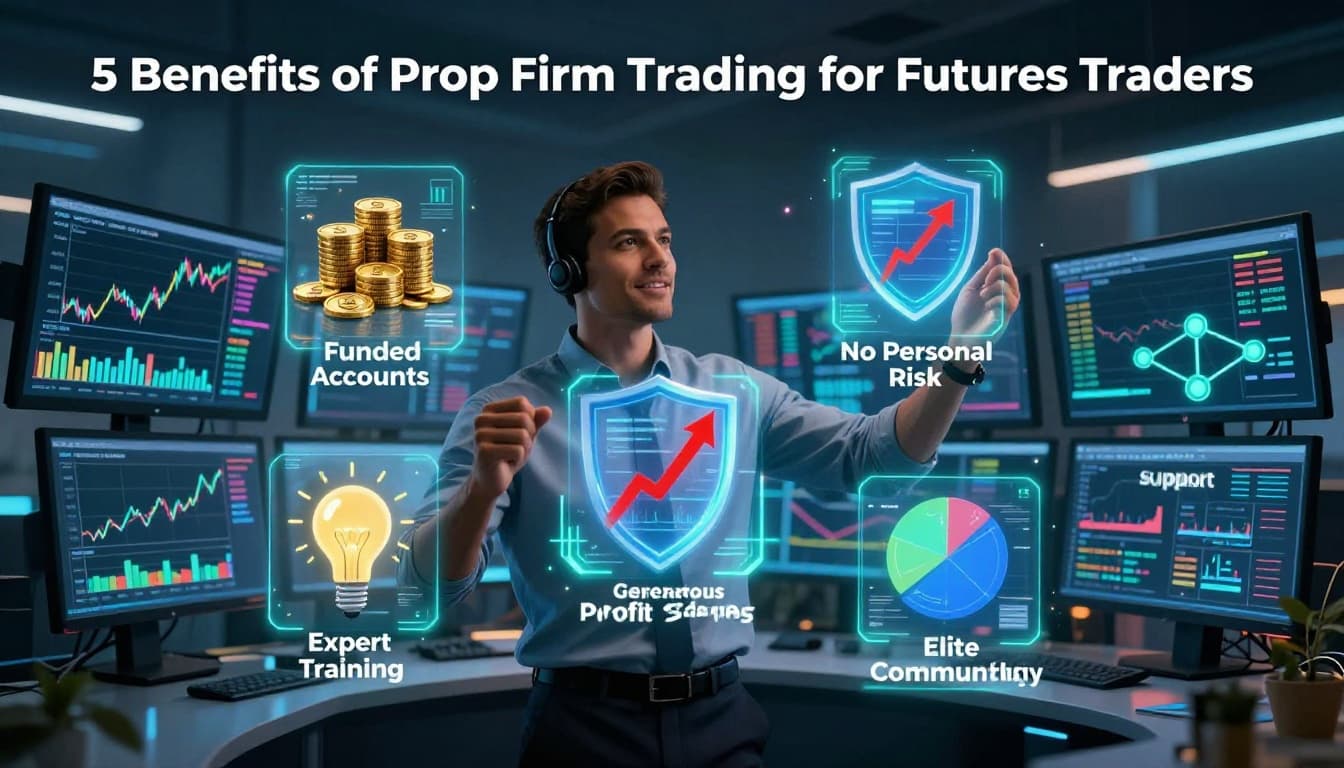
The 5 benefits of prop firm trading can reshape a futures trader's career path completely. Traders can access larger funded accounts ranging from tens of thousands to several hundred thousand dollars in notional value, instead of risking their own capital. This approach amplifies potential returns while keeping personal funds safe.
Prop firms for futures trading have become more popular among traders like us, and with good reason too. These firms give us access to funded trading accounts that work on a profit-split model - usually 70/30 to 90/10 favoring the trader. The firms' educational resources and mentorship programs also help strengthen our trading abilities.
Let's take a closer look at the five key benefits prop firms give futures traders. These advantages can make a real difference in your trading results - from increased trading capital and built-in risk management systems to lower costs, advanced tools, and valuable education resources. Many futures traders choose prop firms to advance their careers, and the reasons are compelling.
Key Takeaways
Prop firms offer futures traders a compelling alternative to traditional retail trading by providing substantial capital access, professional infrastructure, and comprehensive support systems that can accelerate trading careers.
• Access substantial trading capital without personal risk - Trade with $25K-$2M+ funded accounts while risking only evaluation fees, not your savings
• Built-in risk controls prevent catastrophic losses - Daily loss limits and drawdown rules protect against emotional trading decisions and career-ending mistakes
• Enjoy lower costs and better leverage than retail - Reduced commissions and enhanced leverage amplify profit potential for active traders
• Leverage professional-grade technology and execution - Access advanced platforms, ultra-fast execution, and custom analytics unavailable to retail traders
• Accelerate learning through mentorship and community - Benefit from experienced trader coaching, live trading rooms, and peer support networks
The prop firm model creates a win-win scenario where your success directly benefits both parties through profit-sharing arrangements. While not suitable for every trader, prop firms offer a structured pathway to professional trading that removes many barriers faced by individual retail traders.
Access to More Trading Capital
Capital access is the life-blood that draws futures traders to proprietary trading firms. Personal capital limits can hold back even the most skilled trading strategy. Let's take a closer look at why capital plays such a crucial role in futures trading, how prop firms fund traders, and real-life examples that show how capital scaling can transform trading careers.
Why capital access matters in futures trading
These days, having access to capital sets apart consistent traders from those stuck at the retail level. A trader might have excellent strategy, discipline, and risk management skills, but limited capital creates real barriers.
Traders with restricted capital face tough choices. They might over-leverage positions, fail to vary their portfolios, or miss good trading chances. This creates a cycle where retail traders put too much pressure on a single trading account. The result? Emotional decisions and inconsistent results—even with a solid strategy.
Futures trading needs substantial capital because of leverage. While traders can control large positions with small deposits, proper position sizing still needs solid backing. Futures margin requirements vary a lot by contract. Day trading margins for popular contracts can range from $50 to several thousand dollars. Without enough capital, traders must either trade smaller than their strategy needs or take unnecessary risks.
Market volatility also affects how much capital you need. During high volatility periods (VIX above 25), traders might need to cut position sizes by 20-30%. Without enough capital reserves, these adjustments become impossible without abandoning the strategy.
How prop firms fund traders
Prop firms have created clear paths to substantial funding through innovative testing processes. Unlike putting personal savings at risk, prop firms let traders prove their skills without risking their own money.
Most firms use a multi-stage evaluation model:
- Evaluation/Challenge Phase - Traders show their skills using simulated accounts
- Funded Stage - Successful traders get allocated capital (still simulated but with real profit potential)
- Scaling Path - Consistent performers get access to bigger accounts
We assessed traders based on risk management abilities and past performance metrics. The evaluation uses specific parameters like drawdown limits and profit targets. Risk-based allocation models set strict rules: maximum drawdown limits of 2-5%, position sizing caps of 10-15%, and daily loss thresholds between $500-$5,000.
The funding amounts can be huge. Potential capital ranges from $25,000 for junior traders up to $20 million for experienced senior traders. Most individual traders could never reach these levels on their own.
Prop firms usually want at least 3 months of verified trading data before giving larger capital allocations. Traders with a Sharpe ratio above 2.0 often see their capital grow by 25-50% every quarter. This creates a system where skill guides you to greater chances.
Examples of capital scaling in prop firms
Capital scaling stands out as one of prop firm trading's best perks. Your account size isn't fixed - good performance can lead to much bigger trading capital.
FTMO, a leading prop firm, gives traders access to accounts up to $400,000 with room to scale to $2,000,000 through their scaling program. Their approach rewards steady performance with both increased capital and better profit splits from 80-90%.
GFunded takes scaling even further. Traders can start with accounts as small as $20,000 but potentially reach $4,000,000 through their 8-level scaling system. Their profit splits go up to 100% at higher levels.
Apex Trader Funding focuses on futures traders and offers accounts up to $300,000. They have great profit-sharing terms: 100% on the first $25,000+ in profits, then 90% after that.
Topstep gives traders an easy way to start, with accounts up to $150,000 just for futures trading. Their profit model keeps things simple: 100% profit on the first $10,000, then 90% afterward. Traders need only 5 winning days of $150 or more to get their first payout.
FundedNext shows just how high you can go in this field. They offer scaling options from $300,000 up to $4,000,000 and profit splits from 60-95%. They process payouts within 24 hours for eligible requests.

Performance-based increases typically range from 25-100% of your starting capital when you hit monthly profit targets of 5-12%. Success builds on itself, letting skilled traders handle bigger positions over time.
Capital growth associates directly with proven trading expertise. Traders who keep making profits while following risk rules get these steady capital increases. Both sides win: traders get more capital as they prove themselves, while firms reduce their risk through gradual increases.
The numbers tell an interesting story: about 43.41% of evaluation participants move up to a simulated Funded Stage after enrolling. Among those reaching the Funded Stage, 28.56% earn at least one payout from simulated trading gains. While success isn't guaranteed, these numbers show that many disciplined traders advance through the system.
Funded capital removes survival pressure. Traders can stick to their risk rules, handle drawdowns well, run multiple strategies at once, and stay disciplined as markets change. This structured approach lets traders focus on consistent execution instead of worrying about losing their personal accounts.
Built-In Risk Management Systems
Risk management and robust systems are the foundations of successful futures trading. Prop firms have built these safeguards right into their platforms. Let's get into how these systems work and why they matter to your trading career.
Daily loss limits and drawdown rules
Prop firms use two key risk parameters that shape how you trade: daily loss limits and maximum drawdowns. These strategic guardrails will give a solid framework to preserve capital and promote disciplined trading.
Daily loss limits (DLLs) set the maximum amount you can lose in a single trading day before your trading stops automatically. These limits usually range from 2-5% of your account balance. A $100,000 account might have a daily loss limit of $2,000. The system closes all positions and stops further trading until the next session once you hit this threshold.
These limits work so well because you can't negotiate with them. The protection kicks in even if you breach the limit by $1, even if you recover later. You'll get a mandatory break that stops emotional decisions during market volatility.
Maximum drawdown rules work differently than daily limits. A drawdown shows the drop from your highest account balance to the lowest point after that. Prop firms usually pick one of these three drawdown models:
- Fixed drawdown - A static percentage based on your initial balance (typically 6-10%)
- Trailing drawdown - A dynamic threshold that rises with new equity highs but never drops
- End-of-day drawdown - Calculated from your account balance after trading ends
To cite an instance, see a trailing drawdown of 4% on a $50,000 account. Your first equity limit would be $48,000. Your new drawdown limit becomes $49,000 if your equity hits $51,000. Traders can grow steadily this way without getting knocked out by small intraday swings.
The numbers tell an interesting story: traders who keep losses under 50% of their daily limit get funded 2.3 times faster than those who often push the limits. This shows that good risk management points to overall trading discipline.
How risk controls protect traders
In stark comparison to what some believe, these risk controls do more than protect the prop firm's money—they help traders too. They create a well-laid-out framework to execute trades while keeping risk in check.
Risk controls stop career-ending losses. By limiting your daily downside, you'll always have money to trade tomorrow. The math of drawdowns is clear: you need a 25% gain to recover from a 20% loss, but only 5.3% to bounce back from a 5% drop.
These systems give you live feedback on your risk exposure. Smart monitoring tools track positions and P&L non-stop, enforcing rules like daily loss limits. You'll develop better risk awareness—a skill that works in any trading environment.
Prop firms' risk systems teach position sizing discipline. Most firms limit position sizes based on account equity, which stops overleveraging. A $50,000 account trading 3 E-Mini contracts (often the max allowed) would hit nearly the whole daily loss limit with just 3 points against you.
These controls give you mental freedom. Clear decisions come when you know your maximum loss. Set risk limits let you run your strategy without fearing unlimited losses.
Prop firms' data proves these controls boost long-term results. Traders using structured risk rules show more consistent performance than those without guidelines.
Avoiding emotional trading decisions
Prop firms' risk systems' best feature is how they protect you from emotional reactions. Research shows your worst trades usually happen after losses, when emotions trigger big positions, abandoned strategies, and revenge trading.
These systems act as circuit breakers that stop emotional spirals. The platform blocks more trading that day once you hit your daily loss limit—breaking the common urge to make back losses through risky trades.
Psychology plays a big role in performance. Fear can make you exit trades too soon, cutting profits. Greed might push you to take too much risk. Both can stop you from hitting the prop firm's profit targets.
Without solid risk rules, traders often chase losses and ignore red flags. Prop firms prevent these issues by:
- Making traders step back instead of jumping back in after losses
- Setting clear entry/exit rules that cut impulsive choices
- Building systematic practices that reduce emotional interference
- Using daily P&L targets and limits to prevent overtrading
Veteran traders see another mental benefit: these systems ease the pressure of trading big money. Each tick can feel overwhelming with six or seven-figure accounts. Set risk limits make large-account trading mentally manageable.
Prop firms' data backs this up. Traders with structured risk management show better performance metrics, including higher Sharpe ratios and smaller maximum drawdowns. These traders also stay in the game longer by avoiding career-ending losses.
The best part is how these skills work anywhere. Learning disciplined risk management builds habits that help throughout your trading career, whatever money you're trading.
Risk management systems transform how traders see markets. By removing emotions from risk decisions, traders can focus on strategy and market analysis instead of fighting psychological pressure.
Lower Costs and Better Leverage
Prop firms give futures traders a third big advantage - cost efficiency. The financial benefits shine through when you compare prop trading with retail trading, both in commission structures and leverage options. Let's get into how these money-saving perks turn into real-life profit chances.
Reduced commission structures
Commission costs might look small next to profit goals, but they make a big difference in long-term profits, especially if you trade often. Prop firms get much better commission rates than individual retail traders.
This happens because prop firms have more bargaining power. They generate huge trading volumes that let them negotiate better rates with brokers. These savings pass directly to their traders, who pay less for each trade.
Here's how the commission structures stack up:
- Prop trading: Commissions link to share count, not orders. You might pay $0.30 for 100 shares, $3.00 for 1,000 shares, and $30.00 for 10,000 shares
- Retail trading: Flat $10.00 fees per order, including exchange and ECN fees, no matter the size
These differences add up fast. A trader who makes 20 trades daily could save hundreds of dollars each week with prop commission rates.
Prop firms also offer volume discounts that cut costs as you trade more. Active traders can get rates as low as $0.05 per side plus exchange fees. This stepped pricing rewards busy traders with savings retail traders can't access.
Some firms throw in free market data - another big saving. Take CME Level 1 data, which comes free if you make 10+ trades monthly. Retail traders usually pay $50-150 monthly for similar data packages.
Leverage advantages over retail brokers
Leverage stands out as the biggest financial perk prop firms offer futures traders. While retail futures trading has leverage too, prop firms give you access to higher amounts with fewer strings attached.
Retail traders face tough rules about leverage. Many brokers want $25,000 in equity before you can use it, plus they limit you to three-day trades in five days. These rules make it hard for smaller accounts to grow.
Prop traders get leverage based on their skills and risk management. You don't need $25,000 in personal money - instead, you can qualify through evaluation processes that cost hundreds or even tens of dollars.
The difference in leverage is huge. Prop firms often let you control hundreds of times more than your initial investment. You could manage positions worth hundreds of thousands of dollars without risking much personal cash.
Many modern prop firms have dropped activation fees completely. Companies like Tradeify and My Funded Futures offer evaluation accounts with no extra fees after passing. This makes the Total Cost of Funding much lower than firms charging both evaluation and activation fees.
What this means for your profits
Lower costs and better leverage create several ways to boost your trading profits.
Smaller commissions mean more profit from each winning trade. High-frequency traders can turn barely profitable strategies into steady moneymakers. Micros trades at $0.09 per contract versus retail's $0.39+ means 76% more money stays in your pocket.
Better leverage means bigger returns when you're right. Good risk management lets you control larger positions for proportionally larger profits. With $100 and 10x leverage, you control a $1,000 position. A 1% price rise brings $10 instead of just $1 without leverage.
Cost savings let you try different strategies at once. Instead of taking big risks with limited capital, you can spread risk across different markets or timeframes.
Lower entry costs mean less pressure when you start. You can focus on trading well instead of chasing profits to cover your investment.
These benefits grow over time. Save $5 per round-trip trade, make 15 trades weekly, and you're $3,900 richer yearly. Add the ability to control positions 5-10 times larger than normal, and the math works strongly in your favor.
Notwithstanding that, these financial perks come with duties. Leverage works both ways - it makes profits bigger but losses too. Without proper risk control, small price moves against you could mean big losses or wiped-out accounts. This shows why prop firms' risk management systems fit perfectly with these financial advantages.
Advanced Tools and Real-Time Data
Technology gives prop trading firms a powerful edge over their competitors. Professional platforms, fast execution, and custom analytics create advantages that retail traders find hard to match on their own. A look at these advanced tools shows how the right trading setup can boost performance dramatically.
Trading platforms offered by prop firms
Prop firms give their traders access to elite platforms built for futures trading. Most firms don't limit you to just one interface - they offer several options that match different trading styles and priorities.
NinjaTrader is one of the most popular platforms. It offers fast execution, direct market access, and lets traders create custom automation for testing and running strategies. Traders can build automated scripts to enter or exit positions based on their setups, which helps avoid emotional decisions during volatile markets.
Tradovate runs on a cloud system that merges naturally with TradingView. This makes it perfect for traders who work on different devices. You can keep your trading performance steady whatever your location.
Quantower and MultiCharts pack powerful tools for testing strategies and managing orders. These platforms are built with futures traders in mind. They come with advanced charts, automated testing, and detailed analytics that most retail traders can't access.
Speed-focused traders often pick Rithmic's RTrader Pro. It's built for desktop systems that need the fastest possible execution. The platform shows unfiltered depth-of-market data - crucial for strategies that rely on order flow analysis.
Many prop firms now let traders pick their preferred platform. Alpha Futures, to cite an instance, lets you choose from five different platforms: AlphaTicks, NinjaTrader, Tradovate, Quantower, and TradingView. This means you can pick what works best for you instead of forcing yourself to use a platform that doesn't fit your style.
Speed and execution benefits
Fast execution makes or breaks futures trading success. Markets change in milliseconds. Traders with faster systems get better entries and exits.
Prop firms put serious money into their trading servers. They team up with services like Trading FX VPS to give traders ultra-fast virtual private servers. These servers run in premium data centers near major trading hubs - London (LD4), New York (NY4), and Tokyo (TY3). This cuts down the delay between placing orders and getting them filled.
Live market data feeds show traders exactly what's happening. They can adapt their strategy as markets move. This real-time information beats working with delayed data that could be seconds or minutes old - a huge difference in fast futures markets.
Heatmaps and order flow analytics show where money flows and orders stack up. This helps traders spot good setups and avoid traps set by bigger players. These visual tools reveal market psychology in ways that regular indicators can't match.
Market replay features help scalpers and high-frequency traders the most. They can review price moves second by second to improve their timing. Breaking down order flow and trade execution at this detailed level changes how traders learn from their performance.
Custom dashboards and analytics
Today's prop trading platforms do much more than show charts. They've become command centers that track both market conditions and trader performance in real time.
Custom dashboards give prop firms a big tech advantage. TradesViz lets traders build their perfect setup by adding any stats, charts, or widgets they need. This means every piece of important data stays right where you need it.
Performance tracking has gotten much smarter. Platforms now automatically track:
- Trade consistency and patterns
- Volatility groups and time-of-day edge
- Maximum favorable excursion (MFE) and maximum adverse excursion (MAE) dispersion
- Slippage measurements and best-exit variance
- Tagged strategy performance across different market conditions
These tools spot patterns in trading behavior and execution that might go unnoticed otherwise. Automated trade journals tag trades, add notes, and track stats without extra work - making performance reviews easier while keeping data collection steady.
Smart margin calculations fit right into these dashboards. Both traders and prop firms see the real risks in open and planned trades. The math includes complex parts like volatility, contract expiration, strike prices, and risk-free rates - all updated live.
Many firms' main dashboards make it easy to run multiple funded accounts at once, with copy trading built in. Live equity curves and drawdown warnings help traders watch their risk limits without doing math by hand.
This technology creates a cycle of getting better: good data leads to good decisions, which create good results and more useful data to learn from.
Education, Mentorship, and Community
Success in futures trading depends on the human factor. That's why educational resources stand out as the fifth major benefit you get from prop firms. These firms don't just provide capital and technology - they put substantial resources into developing traders through structured learning and community building.
Mentorship programs and coaching
Expert traders serve as the life-blood of prop firm education systems. Many firms give you personal mentorship where seasoned pros give direct feedback on your trading moves and decisions. One-on-one guidance helps you learn by a lot faster than you would from generic trading books.
Each firm's coaching program looks different. Some give you multi-hour personal coaching packages that mix one-hour and two-hour sessions. These custom sessions let mentors break down complex market ideas into bite-sized, useful tasks that match how you learn best.
These mentorship relationships are a great way to get practical knowledge. Your coach analyzes your actual trades instead of theory. They spot patterns in your mistakes and suggest specific fixes based on real market situations. This hands-on guidance teaches you not just what went wrong but why—knowledge you need to avoid similar traps later.
Live trading rooms and webinars
Live learning environments have become powerful teaching tools in prop trading. Professional traders run daily live streams where they analyze current market conditions and explain what they see. These sessions happen during prime trading hours. You can watch pros make decisions as markets move in real-time.
Firms regularly host structured webinars about everything from basic platform use to advanced trading methods. TopstepTV™, to name just one example, streams expert insights every weekday with live group sessions Monday through Thursday. Traders can ask questions and get quick answers about tough concepts in these interactive sessions.
Quality trading rooms don't just tell you when to buy or sell. They explain market context, planning, and risk evaluation. This focus on education helps you build your own analysis skills rather than depending on alerts.
Peer support and trader networks
Community resources build the third pillar of prop firm education. Most firms run active Discord communities where traders connect, share ideas, and talk about what they see in markets. These digital spaces build friendship among traders who face the same challenges and celebrate wins together.
Everyone benefits from sharing knowledge in these collaborative spaces. New traders learn proven methods while veterans sharpen their skills by teaching others. Groups often spot opportunities and risks that solo traders might miss.
These communities give you more than just education - they provide emotional support during tough market periods. Trading can feel lonely, especially when times get hard. Having peers who understand trading's emotional ups and downs builds resilience that technical knowledge can't give you.
Strategy discussion forums let traders compare notes across different market conditions. This creates a living knowledge base that changes as markets evolve. Collective experience helps you guide through complex markets better than you could alone.
Conclusion
Futures traders are increasingly choosing prop firms as their go-to trading vehicle, and there are good reasons why. The biggest advantage is access to substantial trading capital. We can trade accounts worth tens or hundreds of thousands of dollars while putting up minimal personal funds. This scaling of capital helps us bypass years of slow account building.
The built-in risk management systems serve as a safety net against poor trading decisions. Daily loss limits and drawdown rules create boundaries that prevent major losses and help us become more disciplined traders. These protective measures boost our long-term results rather than holding us back.
Money advantages go beyond just having more capital to trade with. Better commission rates and leverage options directly boost our bottom line. For active traders who place multiple trades daily, lower commissions can turn barely profitable strategies into consistent winners.
State-of-the-art technology gives us another edge. Advanced platforms, lightning-fast execution, and custom analytics dashboards provide tools that retail traders can't match on their own. These tech advantages lead to better entries, exits, and overall trading results.
The sort of thing I love most about prop firms is their focus on education and community. From one-on-one mentoring to live trading rooms and trader networks, these connections give us both technical know-how and mental strength during tough market times.
All these benefits create an environment where we can focus purely on trading instead of worrying about preserving capital or platform issues. The profit-split arrangement lines up everyone's interests perfectly - when traders win, prop firms win too.
Prop firms might not suit every trader's needs, but they offer a powerful alternative to building a personal account slowly. Take time to research different firms' evaluation methods, profit splits, and support systems to find your ideal match. The right prop firm partnership could help you achieve trading goals that seemed out of reach with just personal capital.
FAQs
Q1. What are the main benefits of trading with a prop firm? Prop firms offer several key advantages, including access to larger trading capital, built-in risk management systems, lower costs and better leverage, advanced trading tools and real-time data, and educational resources and mentorship programs. These benefits can significantly enhance a trader's potential for success and accelerate their skill development.
Q2. How do prop firms fund traders? Prop firms typically use a multi-stage evaluation process. Traders start with a simulated account to demonstrate their skills. Upon successful completion, they receive allocated capital, often still simulated but with real profit potential. Consistent performers can then gain access to progressively larger accounts, with funding amounts potentially ranging from $25,000 to millions of dollars.
Q3. Are prop firm trades executed with real money? Initially, most prop firm trading occurs on simulated accounts. However, successful traders who consistently meet performance targets may be moved to real-money accounts. The transition to live trading with the firm's capital is typically a gradual process, often starting with smaller test allocations before scaling up to larger amounts.
Q4. How do risk management systems in prop firms benefit traders? Prop firms implement strict risk parameters such as daily loss limits and maximum drawdown rules. These systems protect traders from catastrophic losses, provide real-time feedback on risk exposure, encourage disciplined position sizing, and create psychological freedom by setting clear boundaries. This structured approach often leads to more consistent long-term performance.
Q5. What educational resources do prop firms offer? Prop firms typically provide a range of educational resources, including personalized mentorship programs, live trading rooms, daily market analysis webinars, and peer support networks. These resources help traders accelerate their skill development, gain practical market insights, and build resilience through community support during challenging market periods.