Did you know traders at proprietary trading firms can keep up to 80% or more of their profits while using someone else's capital?
The sort of thing i love about prop firm trading is this profit-sharing model. Proprietary trading firms let traders make their own decisions while using the firm's money. This setup substantially reduces personal financial risk. A trader who makes $100,000 in profits with a 40/60 profit-sharing agreement gets $40,000 while the firm keeps $60,000.
On top of that, it opens doors to trading opportunities in a variety of asset classes like forex, stocks, crypto, and commodities. But traders need to think about risk management too. These firms usually set loss thresholds and will suspend trading activities when reached to prevent further losses.
This piece will show you everything you need to know about trading on a prop firm. You'll learn what proprietary trading companies do, how to navigate evaluation programs, and secure a funded account. We've packed it with practical steps and safety tips to help you start your trip.
What is Prop Firm Trading?
Proprietary trading (prop trading) offers a unique model. Traders use a firm's capital instead of their own to execute trades in various markets. This arrangement creates a different risk-reward structure that appeals to traders who want to advance their careers without substantial personal financial risk.
How prop trading is different from traditional trading
The fundamental approach of prop trading sets it apart from traditional brokerage models. Traditional brokerages require traders to deposit and risk their own capital, while prop trading lets them use the firm's money. Traditional brokers just execute trades on behalf of clients without sharing profits or losses. They focus on earning commissions. Prop firms employ their own funds and share profits with traders based on agreed-upon terms.
There's another significant difference in risk management protocols. Prop firms put their capital at stake, so they set strict risk controls. These include daily loss limits (typically 3-5% of allocated capital) and maximum drawdown thresholds (often 10-20% of trader's capital). Traditional retail trading lacks these restrictions, and traders must take complete responsibility for their risk decisions.
Why firms use their own capital
Prop firms have strategic reasons to use their own capital. This approach lets them capture full trading profits rather than just commissions from processing client trades. Using proprietary funds gives them more operational flexibility and freedom from client reporting obligations.
The structure allows prop firms to act as intermediaries that help stabilize asset prices in financial markets. These firms boost market liquidity and efficiency by participating in equities, derivatives, and forex.
Common misconceptions about prop firms
Many myths surround prop trading firms. People often think prop trading is like gambling. The reality shows successful prop trading depends on disciplined analysis, strategic thinking, and strong risk management—not luck or chance.
Newcomers think prop trading exists only for experienced Wall Street veterans. Many firms actually seek talented individuals with varying experience levels. They offer evaluation programs that create level playing fields to demonstrate trading skills.
Some traders believe all prop firms try to deceive people and collect evaluation fees. While some questionable entities exist, reputable prop firms build their business around funding capable traders rather than exploiting them. Success comes from finding 10-year-old firms that offer genuine capital, clear rules, and defined advancement paths.
How Do Prop Firms Work?
Proprietary trading firms work through a structured framework that lets talented traders use significant capital without risking their own money. These firms have built specific systems to spot skilled traders, manage risk, and share profits.
Capital allocation and trader funding
Prop firms allocate capital based on a trader's proven skills and risk management abilities. New traders can start with accounts from $5,000 to $50,000. Experienced traders might handle up to $600,000. The capital allocation process uses sophisticated risk assessment techniques to maximize returns and minimize potential losses. Teams carefully review performance metrics before they decide optimal funding levels for each trader.
Evaluation programs and funded accounts
Evaluation processes serve as the gateway to prop firm trading. Programs known as challenges or assessments test traders' abilities before they get funded accounts. Firms look at several factors during evaluation. Risk management practices, profitability percentage, and consistent performance over time matter most. Successful traders receive funded accounts—either simulated or live—and start trading with the firm's capital under set guidelines.
Profit sharing and performance tracking
Profit splitting forms the core compensation structure in prop trading. Most firms give traders between 50% to 90% of generated profits. Some offer up to 100% after hitting high-tier growth targets. To name just one example, a trader making $100,000 in profits with a 40/60 split would get $40,000 while the firm keeps $60,000. Traders usually receive payouts weekly to monthly. Well-established firms process withdrawals within 24 hours.
Technology and trading tools used
Prop firms utilize sophisticated technology to support their traders. Advanced trading platforms like MetaTrader, cTrader, and proprietary dashboards provide immediate data. On top of that, it offers risk management tools that help traders stay within prescribed limits and avoid rule violations. Analytics software tracks performance metrics so traders can identify strengths and improve strategies. In fact, these innovations have made prop trading more available, letting retail traders join what used to be an institutional-only domain.
How to Start Trading with a Prop Firm
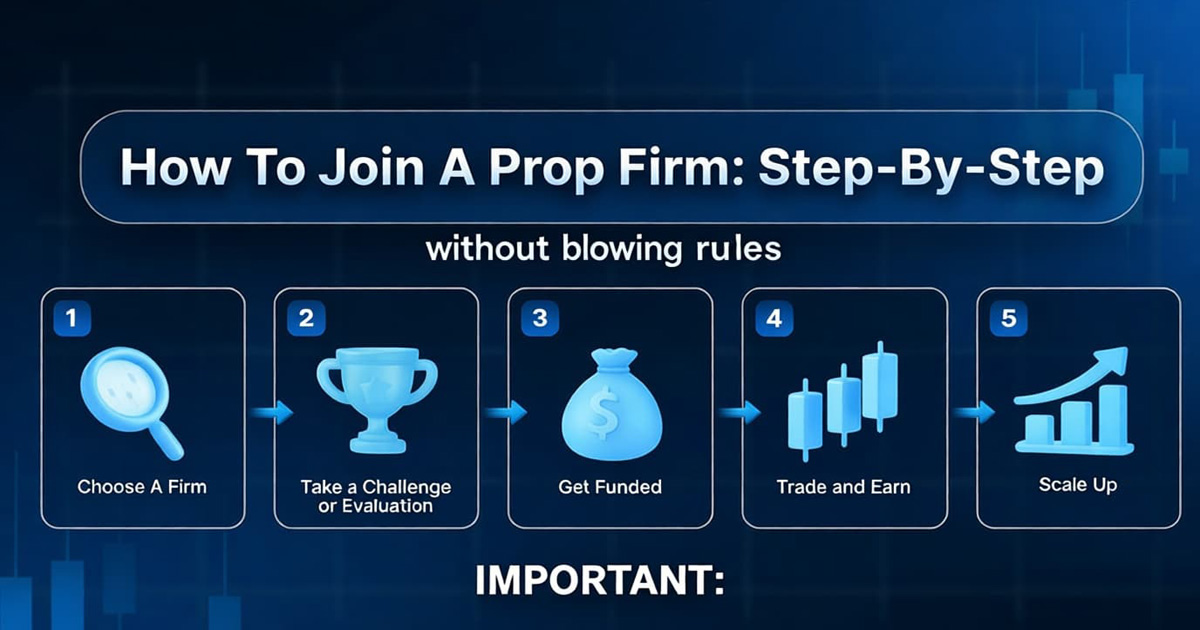
A methodical approach helps you start your prop trading career, from selecting the right firm to managing a funded account. Here's a breakdown of the essential steps.
Step 1: Research and choose a reputable firm
You need to examine prop firms that match your trading style. Look at key factors like funding programs, profit splits (typically 50-90%), evaluation processes, and specific trading rules. Take time to examine fee structures, withdrawal policies, and scaling plans before you commit. Check the firm's registration and regulatory status to protect yourself from potential fraud. Look for reviews from actual funded traders instead of promotional materials.
Step 2: Understand the evaluation process
Prop firms test your trading skills through evaluation systems before giving you access to capital. These tests let you trade virtual funds while meeting specific profit and risk targets. You'll find different challenge structures: one-step challenges (8-10% profit target), two-step challenges (10% first phase, 5% second phase), or instant funding options. Learn about rule violations that can end your account, especially when you have maximum daily loss limits (3-5%) and overall drawdown thresholds (8-10%).
Step 3: Pass the trading challenge
Your success in completing the challenge depends on disciplined risk management. Keep your risk to 1-2% per trade—this rule is non-negotiable. Prop firms value steady performance over aggressive trading, so focus on consistency. Keep detailed records of each trade and track your daily progress against profit targets and drawdown limits. Note that challenges test how well you work within boundaries while protecting capital.
Step 4: Begin trading with a funded account
Successfully completing evaluation requirements gives you access to a funded account. This is where your professional prop trading career truly begins. Risk management becomes even more critical with real capital at stake. The firm will closely monitor your performance metrics to ensure you follow trading rules. Many firms let traders increase their capital allocation as they show consistent profitability through scaling plans.
Risks and Safety Tips for New Traders
Prop firm trading comes with its own set of risks that traders need to handle with care. Your success relies not just on trading abilities but on your grasp of specific risk parameters that safeguard both your capital and the firm's money.
Understanding leverage and drawdowns
The power of leverage in prop trading can make your profits or losses much larger. Most prop firms let you work with leverage from 1:30 to 1:100, which means you can manage bigger positions with less capital. In spite of that, you need strict discipline because even small price changes can lead to big losses that might exceed your original investment.
Your account faces two main types of drawdowns - the maximum allowed losses before termination:
- Balance-based drawdown: This only counts closed trade results and ignores unrealized profits/losses
- Equity-based drawdown: This looks at both realized and unrealized P&L to calculate limits
The typical firm sets daily drawdowns at 5% and maximum drawdowns around 10%. Your account could close right away if you go past these limits, even for a moment.
Regulatory and firm-related risks
Regulators worldwide keep a close eye on proprietary trading. Prop firms must follow anti-money laundering (AML) and know-your-customer (KYC) rules. You should check if a firm is properly registered to avoid future problems.
The risks grow higher with unregistered firms that might stop operating because of regulatory action, which puts your accounts and future payments at risk. On top of that, some regions have strict rules about capital requirements and algorithmic trading that shape how firms work.
How to read and understand trading agreements
The agreements need your full attention, especially parts about profit-sharing, risk rules, and trading limits. Look out for hidden fees that could eat into your profits. You should spot any unusual rules about minimum trading days or consistency requirements early.
Be wary of firms that use aggressive marketing to promise unrealistic returns or guarantees. Good firms stay open about their operations, performance numbers, and how they handle risk.
Tips for managing risk and staying compliant
Smart position sizing makes a difference - keep your risk between 0.5-2% per trade so you can handle several losing trades without hitting drawdown limits. Put stop-loss orders in place right away to control possible losses on each trade.
Set your personal daily loss limits well under the firm's maximum. To cite an instance, if your firm stops you at 5% loss, you might want to stop trading at 3% to stay safe.
Try to vary your approach across different asset classes, trading strategies, and financial tools to reduce potential risks. Your trading journal should record every move you make. This helps you study your performance and make your strategy better.
Conclusion
Prop firms give traders at all experience levels a chance to succeed. These firms let you trade substantial capital without risking your own money. You can keep 50-90% of your earnings through their profit-sharing plans.
Your success starts with picking a good firm that matches your trading style. The evaluation process serves as your entry point to funded trading. Risk management remains the life-blood of lasting success in this field.
Note that prop trading brings its own set of challenges. You must watch drawdown limits, leverage rules, and firm policies closely. Successful prop traders build careful habits around position sizing, stop-loss placement, and daily risk checks.
Prop firm trading is a chance for skilled traders to build professional careers, despite these challenges. The knowledge in this piece helps you focus on steady results rather than quick gains. Your priority should be protecting capital instead of aggressive trading.
The prop trading world keeps changing and talented traders worldwide can access it easily now. Being organized and following this approach will help you get the most benefits while reducing risks of trading with a prop firm. Your trading experience starts with knowledge, grows with discipline, and flourishes with practice.
Key Takeaways
Here are the essential insights every new trader needs to know before starting with a proprietary trading firm:
• Prop firms let you trade with their capital while keeping 50-90% of profits, eliminating personal financial risk while providing access to substantial funding up to $600,000.
• Success requires passing evaluation challenges with strict risk management - limit risk to 1-2% per trade and stay within daily loss limits (typically 3-5%) to avoid account termination.
• Choose reputable, regulated firms carefully by verifying registration status, reading actual trader reviews, and understanding all fees and profit-sharing agreements before committing.
• Drawdown limits are non-negotiable - most firms enforce 5% daily and 10% maximum drawdowns, with immediate account closure for violations, making disciplined position sizing critical.
• Focus on consistency over spectacular gains during evaluations and funded trading, as prop firms value steady performance and capital preservation above aggressive trading tactics.
The key to prop trading success lies in treating it as a professional endeavor that rewards discipline, risk management, and consistent performance rather than gambling or get-rich-quick schemes.
FAQs
Q1. What are the main benefits of trading with a prop firm? Prop firms allow traders to access large amounts of capital without risking personal funds. Traders can keep 50-90% of profits while gaining experience in a structured environment with professional tools and risk management systems.
Q2. How does the evaluation process work for prop firm trading? Most prop firms use a multi-step evaluation process. Traders typically pay a fee to participate in a trading challenge, where they must meet specific profit targets while adhering to strict risk management rules. Successful traders then gain access to funded accounts.
Q3. What are the key risks to be aware of when trading with a prop firm? The main risks include strict drawdown limits (usually 5% daily and 10% maximum), potential account termination for rule violations, and the possibility of encountering unregulated firms. It's crucial to thoroughly research and choose reputable, regulated prop firms.
Q4. How much capital can a trader access through a prop firm? Capital allocation varies widely among firms. Beginning traders might start with accounts ranging from $5,000 to $50,000, while experienced traders can potentially manage up to $600,000. Many firms offer scaling plans to increase capital as traders demonstrate consistent profitability.
Q5. Is prop firm trading suitable for beginners? While prop trading can be a good way for beginners to gain experience without risking personal capital, it requires a solid understanding of trading fundamentals and strict discipline. Beginners should focus on developing consistent strategies and risk management skills before attempting prop firm challenges.