
A prop firm challenge opens doors to trading accounts ranging from $1K to $800K+ without putting your own money at risk. The global prop trading industry has reached a valuation exceeding 20 billion USD, and experts project yearly growth of about 7%.
Traders worldwide have embraced prop trading challenges as a way to access large capital pools while keeping their personal risk low. The rules are simple. You trade on simulation accounts under specific conditions and must hit an 8-10% profit target. You also need to stay within 5% daily and 10% total drawdown limits. The concept makes perfect sense - show your trading expertise in a controlled setting, and prop firms will fund your future trades.
This piece breaks down the mechanics of prop firm challenges, explores various challenge types, and reveals what it takes to succeed. The timing couldn't be better - global interest in these opportunities has skyrocketed by more than 500% from 2020 to 2024. Whether you're a prop firm trading novice or ready to take on a challenge, you'll find the guidance you need here.
What is a Prop Firm Challenge?
A prop firm challenge works as a structured assessment system that reviews traders before they can access substantial trading capital. Think of it as an exam where traders must show they can make profits consistently within specific risk parameters. Traders need to prove their skills through this review process before they can manage a firm's capital.
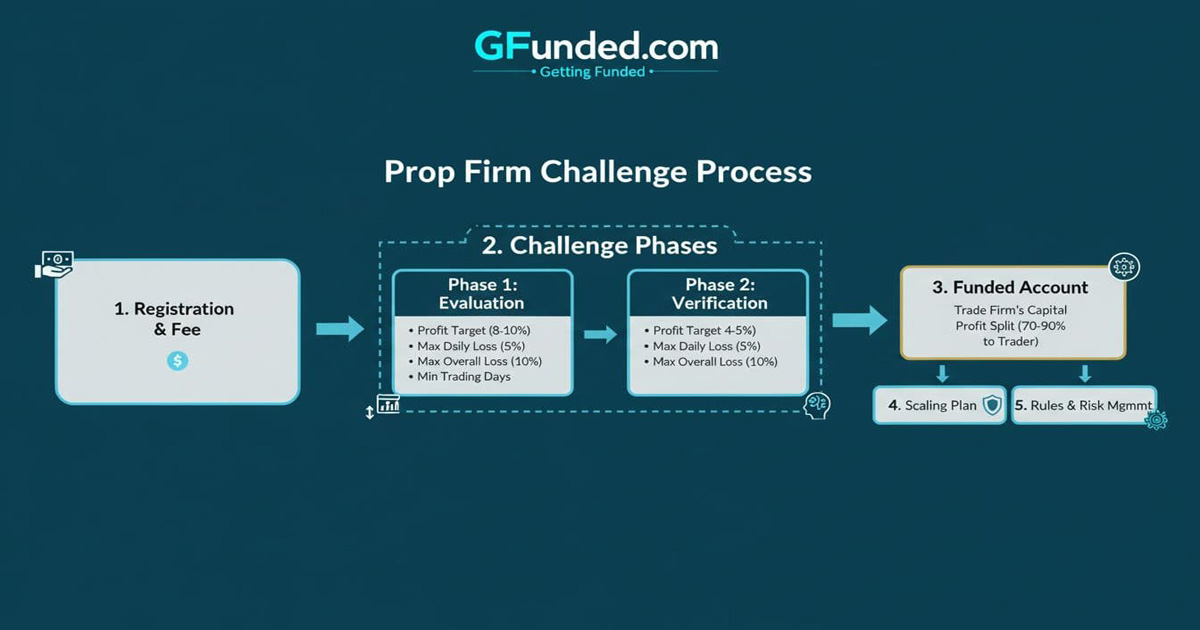
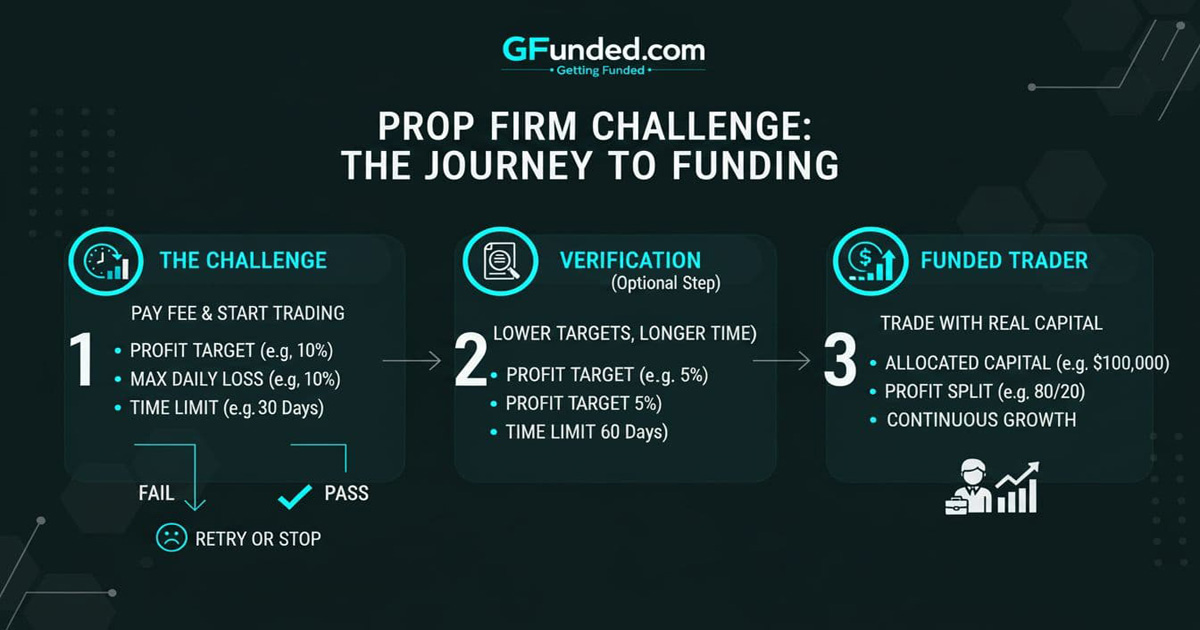
The standard prop firm challenge gives traders a simulated account with virtual funds. They must reach specific profit targets without breaking maximum drawdown limits or other risk criteria. These reviews usually have two phases. The first phase requires reaching profit targets (often 8-10%) with strict risk boundaries. A verification phase follows with slightly relaxed targets to confirm consistency.
How it is different from personal trading
Personal trading and prop firm trading are two completely different ways to participate in the market. Personal trading means I must fund my account and take all losses. This creates a unique mental pressure - the fear of losing my own money can affect my decisions. Many traders hesitate or make emotional choices.
Prop firm challenges give traders a clear path to trade substantial capital without huge personal financial risk. To cite an instance, see how instead of putting $100,000 of my own money with a broker, I might pay a small evaluation fee (typically $80-$250) to access a funded account of the same size after passing the challenge.
On top of that, it comes with strict risk management rules including:
- Daily loss limits (often balance-based or equity-based)
- Maximum drawdown limits (usually fixed at around 10%)
- Trailing drawdowns (often the toughest rule)
- Sometimes consistency requirements that limit "one big day" profits
These rules create a disciplined framework that helps many traders, especially those who are still learning risk management skills.
Why prop firms use challenges to review traders
Challenges are the foundation of a prop firm's business model. We used these evaluations as filtering systems to find skilled traders from a large pool of applicants. Firms would face huge financial risks by funding unproven traders without these screening methods.
The challenge structure helps prop firms review several vital factors:
- Risk management capability
- Trading discipline and consistency
- Knowing how to follow rules and guidelines
- Performance under pressure
These challenges let firms see how traders handle drawdowns, manage losing streaks, and respond to volatile market conditions. This evidence-based approach helps firms find traders who respect risk boundaries - a key factor in protecting the firm's capital.
The evaluation systems help prop firms grow their operations quickly. Standardized challenge structures let firms process thousands of traders consistently while gathering performance data automatically. This creates an eco-friendly business model where growth doesn't overwhelm internal resources.
Successful traders get substantial rewards - access to much larger trading capital with profit-sharing arrangements (typically 70-90% goes to the trader). This creates a partnership where both trader and firm want the same thing: consistent profits.
Prop firm challenges keep growing in popularity. They make it easier for talented traders worldwide to access significant positions without needing large personal accounts.
How a Prop Firm Challenge Works
The trip to becoming a funded prop trader follows a clear path. Traditional trading puts your own money at risk, but prop firm challenges review your skills through simulation before giving you substantial funding. Here's a breakdown of the five core steps.
Step 1: Choose your account size and challenge type
You need to pick both your account size and challenge structure first. Account sizes range from $5,000 to $400,000. Entry-level accounts ($5,000-$25,000) cost between $50-$300, while intermediate accounts ($50,000-$100,000) run $400-$800. Your experience level and risk tolerance should guide this choice.
You can choose from one-phase evaluations (direct approach), two-phase challenges (industry standard), three-step challenges (full picture), or instant funding (immediate access with higher fees). Each option comes with its own rules and benefits. One-phase challenges give you a faster path, while two-phase structures let you show consistency over time.
Step 2: Trade on a demo account under ground conditions
The firm gives you access to a simulated trading environment after you pick your challenge. These accounts use virtual funds but match real market conditions with similar spreads, execution times, and volatility patterns. This lets firms see how you perform without putting actual money on the line.
Results matter less than how you implement your strategy at this point. The demo environment gives you a chance to learn platform specifics and challenge parameters without financial stress. Note that your demo trading should match your funded approach - traders often fail because they trade differently with real money.
Step 3: Meet profit targets without breaking rules
You must hit specific profit targets while following strict risk rules. Most firms want 8-10% profit from your account balance, though some ask just 5%.
These risk boundaries must be respected:
- Daily drawdown limits (usually 3-5% of equity)
- Maximum total drawdown (typically 6-10%)
- Position size restrictions based on account type
- Minimum trading days requirements (often 5-10 days)
Breaking any rule gets you disqualified whatever your profits. Prop challenges test your risk discipline more than your ability to generate profits.
Step 4: Pass phase 1 and phase 2 (if applicable)
The standard two-phase model moves you to verification after you pass the original evaluation. Verification usually has easier targets - often half of what phase 1 required. To cite an instance, a phase 1 target of 8% profit might drop to 4% in phase 2.
The second phase proves you're consistent, not just skilled. It helps firms spot the difference between lucky streaks and real trading talent. Some firms have dropped this step (one-phase challenges), while others added a third phase to get a full picture.
Step 5: Get funded and start earning
Your transition to a funded account happens after passing all evaluations. Each firm handles this differently, but they all check your account and verify your trading history. Many firms switch accounts automatically at market close, and your funded account shows up the next trading day.
Funded accounts keep similar rules to your evaluation - same drawdown math, position limits, and trading restrictions. The big change comes in profit-sharing, with firms giving traders 70-90% of profits. You'll also face some rules for withdrawals - many firms won't let a single day's profit exceed 30% of your total earnings.
Funded traders can grow their accounts too. After showing steady profits for 3-4 months, many firms boost your capital by 20-50%.
Key Rules and Evaluation Criteria
Your success in a prop firm challenge depends on how well you understand and follow their evaluation criteria. These rules help identify disciplined traders who can make profits without taking too much risk. Let's get into the key parameters that govern prop trading challenges.
Profit targets and drawdown limits
Profit targets are the life-blood of prop firm evaluations. They usually range between 8-12% for traditional challenge first phases. The targets change based on challenge structure:
- One-phase challenges: 8-12% within 30 days
- Two-phase models: 8-12% for Phase 1, followed by 5-8% for Phase 2
- Three-step models: 8-10% for Phase 1, 5-6% for Phase 2, and 3-4% for Phase 3
Drawdown limits set vital boundaries that protect capital. They come in two main forms:
-
Maximum absolute drawdown: The biggest allowed decline from your original account balance, usually 4-10% depending on the firm.
-
Daily drawdown: The maximum loss you can have in a single trading day, often limited to 2-5% of account equity.
Knowing how firms calculate drawdowns is vital since methods vary a lot. Some firms look at closed trades only, which lets you hold underwater positions. Others use floating (unrealized) equity calculations, so open positions count toward limits right away.
Time limits and minimum trading days
Time frames matter in prop firm challenges, though this is changing. You get 30 days per phase in traditional challenges. Some newer firms now offer no-time-limit evaluations.
You need to trade on multiple days to complete a challenge. The required number varies between firms:
- Standard requirement: 5-10 days
- Industry range: 1-40 days based on firm and account size
Financial markets expert Arjun Mandal says: "Prop firms usually require a minimum of 4 trading days to prevent luck-based passing and ensure consistency". This helps firms see your risk management and strategy skills over time instead of just one or two lucky trades.
Consistency and trading behavior
Prop firms look at various metrics beyond profit targets to assess trading consistency:
-
Profit distribution: Your total profit can't come from just one session - some firms cap it at 50% per day.
-
Reliable execution: Your risk management practices and progress toward goals need to stay steady.
-
Discipline: Following trading guidelines shows you know how to stick to set parameters.
FundingPips shows how these requirements work. They want 7 profitable days with at least 0.25% profit each day by the end of every 30-day period.
Restrictions on instruments and strategies
Prop firms have specific rules to stop market manipulation and excessive risk-taking:
Common banned strategies include:
- High-frequency trading and hyperactivity (over 200 trades daily)
- Latency arbitrage and tick scalping
- Grid trading and Martingale strategies
- News trading during big economic events
Trading right before or after major economic announcements is often not allowed. FundingPips won't let you execute orders 5 minutes before and after high-impact news events and speeches.
Position and lot size limits keep risk in check. Alpha Capital shows this with their $5000 accounts - you can trade maximum 1.25-2.5 lots based on challenge type.
Breaking these rules means immediate disqualification, whatever your profits. The best prop traders keep track of these parameters and build strategies that work within these limits.
Types of Prop Firm Challenges
Prop firms design their challenge formats to match different trading styles and experience levels. Each model strikes a unique balance between accessibility, depth of evaluation, and risk parameters.
1-step vs. 2-step evaluations
One-step and two-step challenges have been around for over a decade in the prop trading industry. These two approaches differ mainly in how they evaluate traders.
One-step challenges pack everything into a single phase with higher profit targets (8-10%) and stricter risk limits. Traders who want quick access to funded accounts often prefer this streamlined option. These challenges run for set time periods and cost less upfront.
Two-step challenges split the process into two distinct phases:
- Phase 1: Original evaluation targeting 5-8% profit
- Phase 2: Verification phase aiming for 4-5% profit
Major firms stick to this dual-phase system because it gives them a full picture of a trader's skills. The upfront cost runs higher, but traders get more room with drawdown limits (8-10%) compared to most one-step options.
Your trading style usually determines which format works best. Aggressive traders lean toward one-step models because they're quick and simple. Conservative traders usually pick two-step formats to show they can perform consistently.
Instant funding models
Instant funding emerged as one of the newest breakthroughs in prop trading. This approach skips evaluation phases completely - traders get funded accounts right after payment.
The benefits stand out:
- No stress from evaluations or waiting
- You can withdraw profits right away
- Simple drawdown rules (often static instead of trailing)
In spite of that, this convenience comes with trade-offs. Traders pay more upfront compared to regular challenges of the same size. The drawdown limits also tend to be tighter (usually 4-8%) than traditional challenges.
Industry experts point out that these programs attract experienced traders who know how to stick to strict risk management. Companies like Leeloo and SurgeTrader made this model popular by marketing it to traders who want to skip evaluation periods.
Hybrid and flexible challenge formats
Firms created hybrid approaches that mix traditional challenge elements with adjustable parameters. These new formats address specific needs that standard models miss.
Three-step challenges add an extra evaluation phase to the usual two-phase system. Traders progress through three distinct stages, each requiring about 6% profit. This method helps firms identify truly consistent performers through step-by-step progression.
Some hybrid models remove certain rules completely. To name just one example, some firms focus only on risk management without profit targets or time limits. Part-time traders, swing traders, and those who prefer steady account growth find these flexible programs helpful.
The development of challenge formats shows how the industry adapts to trader needs. Each model has its strengths, and picking the right challenge depends on your trading style, experience, and financial goals.
Tips to Pass a Prop Firm Challenge
Getting through a prop firm challenge takes more than knowing the rules - you just need disciplined execution and emotional control. Industry data shows that all but one of these traders fail prop firm evaluations. The main reason isn't lack of knowledge. It's the behavioral factors that affect trading decisions.
Stick to a proven strategy
Before starting any prop firm challenge, you should focus on a single, well-tested strategy instead of experimenting during the evaluation. Research shows that traders who stick to one proven approach during challenges succeed more often than those who switch methods mid-evaluation.
First, pick a strategy you've already confirmed through backtesting and forward testing. This builds confidence in your approach and removes the uncertainty that often causes hesitation or second-guessing. Expert traders say, "A solid trading plan helps automate your decisions to a degree while giving you something to fall back on when emotions run high".
Next, create a complete trading plan with:
- Specific entry and exit rules
- Risk-reward parameters (shoot for at least 1:2)
- Position sizing guidelines
- Market conditions that suit your strategy
Manage risk carefully
Risk management is the backbone of successful prop trading challenges. In fact, many professional traders use stricter risk controls than their firms require. This creates buffer zones that protect against unexpected volatility.
These risk practices matter most:
- Limit risk to 0.25-1% per trade
- Set a personal daily loss cap below the firm's limit (if your firm allows 5%, aim for 2-3%)
- Use stop-loss orders on every position
- Make position sizes smaller during high volatility periods
"Unless you come at it from a risk-first approach, it really doesn't matter what else you do," explains Justin from PropAccount. Risk management should be your main edge rather than just focusing on profit targets.
Avoid overtrading and emotional decisions
Overtrading is one of the most common reasons traders fail prop challenges. A limit of 2-3 trades per day forces selectivity and stops impulsive decisions.
Emotional discipline becomes crucial during evaluations. The 3-Strike Rule works as an effective safeguard: after three consecutive losses in a single day, stop trading. This prevents the dangerous cycle of revenge trading that often breaks drawdown limits.
Your pre-trade checklist should include:
- Does this setup match my strategy exactly?
- Is my risk-reward ratio favorable (minimum 1:2)?
- Am I trading within my daily risk limit?
- Am I calm and making rational decisions?
"Trading is 20% strategy and 80% psychology," notes an industry expert. "The strategy that got you to an 80% win rate in demo trading is worthless if you can't control the voice in your head".
Use demo trading to prepare
Demo account practice helps you prepare for prop firm challenges. Successful traders use demo accounts with purpose, not just placing random trades.
Demo practice works best when you:
- Copy exact challenge conditions (account size, drawdown limits)
- Apply realistic leverage and position sizing
- Trade the same instruments you plan to use in the actual challenge
- Keep a detailed journal of trades and emotional states
In the end, treating your demo account like a funded account builds the psychological foundation you need to succeed. These structured techniques help traders improve their chances of getting prop firm funding.
What Happens After You Pass
Getting through a prop firm challenge marks the start of your trip as a funded trader. A new phase filled with fresh opportunities and responsibilities awaits after you prove your trading skills.
Transition to a funded account
The prop firm will verify your credentials before giving you access to your funded account. You need to complete Know Your Customer (KYC) verification, which takes about 24-48 hours. A passport or driver's license serves as proof of identity, and a utility bill or bank statement works as proof of address.
The next step involves signing a trading agreement that spells out the rules and profit-sharing details. Your account becomes active right after completing these steps, and you can start trading with the firm's capital.
Profit sharing and withdrawal rules
Prop firms share profits with their traders through a percentage-based model. Here's what traders typically receive:
- 70% to 80% for standard accounts
- Up to 90% for advanced accounts
- Elite performers can earn 95-100% in some cases
Each firm handles payouts differently. Some process withdrawals weekly on Wednesdays, while others pay bi-weekly or monthly. The minimum withdrawal amount ranges from $50 to $500. Many firms require traders to meet specific targets first, such as achieving five profitable trading days.
Scaling plans and long-term growth
Prop trading's biggest advantage lies in its scaling opportunities. Firms offer clear paths to increase your capital allocation when you perform well consistently.
Some programs let traders grow from $10,000 to $600,000 by hitting specific profit targets, usually 5-15% over set timeframes. These plans work in tiers - starting with 25% account increases and moving up to 50% or more as traders prove their consistency.
Top performers can tap into additional perks at certain firms. These benefits include monthly salaries ($750-$1,500), better profit splits, and custom trading conditions. Prop trading opens doors not just to immediate profits but creates a path toward substantial long-term wealth building.
Conclusion
Prop firm challenges are available to traders who want to manage large capital without putting their own money at risk. These evaluations act as filters to identify disciplined traders who can make consistent profits while following strict risk rules.
Traders succeed in these challenges through discipline rather than exceptional returns. We learned that traders who focus on managing risk instead of chasing profits tend to do better over time. The rules protect your capital and help you grow, even though they might feel limiting at first.
Today's market offers different challenge formats to match your trading style and experience. One-step challenges get you funded faster. Two-step models give a more complete assessment. Some programs even offer instant funding if you can pay higher fees upfront.
You should view prop firm challenges as career opportunities instead of quick money schemes. Once you pass your evaluation, you'll get profit-sharing deals, withdrawal rights, and room to grow. This can turn your trading hobby into a real profession.
Keep in mind that all but one of these traders fail these challenges. This shows both how tough and valuable these opportunities are - firms want skilled traders who know how to handle risk. Your success depends on following rules, controlling emotions, and using proven strategies.
The prop trading industry grows faster each day, creating new opportunities for disciplined traders worldwide. These programs give you a real shot at professional trading without risking everything you own. Good preparation, steady execution, and emotional control will boost your chances to join the elite group of funded traders who manage large capital and share profits.
Key Takeaways
Prop firm challenges offer traders access to $10K-$800K+ in capital without personal risk, but success requires strict discipline and risk management skills.
• Prop challenges test risk discipline more than profit ability - only 5-10% pass due to rule violations, not lack of trading skills.
• Success requires proven strategy consistency: stick to one tested approach, risk max 1% per trade, and avoid overtrading emotions.
• Two-phase challenges (8-10% then 4-5% profit targets) remain industry standard, offering thorough evaluation with reasonable drawdown limits.
• After passing, funded traders earn 70-90% profit splits with scaling opportunities from $10K to $600K+ based on performance.
• Risk management is paramount: daily loss limits, maximum drawdowns, and minimum trading days separate successful candidates from failures.
The key insight is that prop firm challenges democratize access to substantial trading capital while teaching essential risk management habits. Rather than viewing them as quick profit opportunities, approach these evaluations as structured pathways to professional trading careers with long-term scaling potential.
FAQs
Q1. How does a prop firm challenge work? A prop firm challenge is an evaluation process where traders demonstrate their skills on a simulated account. Traders must meet specific profit targets while adhering to risk management rules. If successful, they gain access to trade larger funded accounts and share profits with the firm.
Q2. What happens if I lose money during a prop firm challenge? If you exceed the maximum drawdown limit during a challenge, your account will be closed. However, you are not responsible for repaying any losses. The risk is limited to the initial challenge fee you paid to attempt the evaluation.
Q3. How do prop firms make money if I'm trading with their capital? Prop firms primarily generate revenue from challenge fees paid by traders attempting to pass evaluations. They also benefit from profit-sharing arrangements with successful funded traders. Additionally, they may copy-trade top performers to generate profits directly.
Q4. Can I trade any instruments or strategies in a prop firm challenge? Most prop firms have restrictions on tradable instruments and prohibited strategies. Common restrictions include limits on high-frequency trading, grid or martingale strategies, and trading during major economic news events. Always review the specific rules of your chosen firm.
Q5. What are the advantages of trading with a prop firm versus my own capital? Trading with a prop firm allows you to access much larger account sizes without risking substantial personal capital. It also enforces disciplined risk management practices. However, you must adhere to the firm's rules and share profits. Trading your own capital offers more flexibility but requires more personal risk.